Acetamide
Molecular Structure: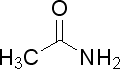
MDL:
MFCD00008023
Molecular Formula:
C2H5NO; CH3CONH2
Molecular Weight:
59.07
Alias:
醋酸胺
Amide C2
Product order:
| Name |
Specifications |
Packing |
Price |
Delivery |
| Acetamide |
GCS,≥99.5% (GC) |
5g |
RMB 83.6 |
Consulting service |
| Acetamide |
AR,99% |
250g |
RMB 30.8 |
Consulting service |
| Acetamide |
AR,99% |
1kg |
RMB 94.6 |
Consulting service |
| Acetamide |
99.8%,升华纯化 |
100g |
RMB 119.9 |
Consulting service |
| Acetamide |
99.8%,升华纯化 |
500g |
RMB 427.9 |
Consulting service |
Character:
白色透明结晶,纯品无气味,不纯时具有鼠臭味,易潮解。1g溶于0.5ml水、2ml乙醇、6ml吡啶。能溶于水、醇、吡啶、氯仿、甘油和热苯,几乎不溶于乙醚。低毒,最小致死量(大鼠,经口)360mg/kg。经试验表明,对实验动物有潜在致癌作用。对皮肤、黏膜有较弱的刺激性。
密度:1.159
熔点:81℃
沸点:222℃
折光率n20/D:1.4274
Quality Standard:
项目Item 分析纯 化学纯
(AR) (CP)
含量(CH3CONH2)Assay,% ≥ 99 98.0
凝固点Solidifying point℃ ≥ 77.0 76.0
水不溶物lnsoluble matter in water,% ≤ 0.02 0.03
游离酸(以CH3COOH计)Free acids,% ≤ 0.2 0.5
灼烧残渣(以硫酸盐计)Residue,% ≤ 0.01 0.03
氯化物(Cl)Chloride,% ≤ 0.002 0.005
硫酸盐(SO4)Sulfate,% ≤ 0.002 0.005
乙酸盐(CH3COO)Acetate,% ≤ 0.2 0.5
重金属(以Pb计)Heavy metals,% ≤ 0.001 0.002
Storage:
密封干燥保存。
用途 熔融后作为许多无机和有机化合物的优良溶剂,也用于有机合成增塑剂,酒精变性剂,加溶剂,稳定剂。
Related Products
- 2-Methyl-3-nitroaniline
- 3,3'-Diaminobenzidine
- (S)-(+)-3,3-Dimethyl-2-butylamine
- 4-Methoxyphenethylamine
- N-Methyldiethanolamine
- 4-Nitrobenzenesulfonamide
- Nα-Benzoyl-DL-arginine β-naphthylamide hydrochloride
- 2,6-Dichloro-4-trifluoromethylaniline
- Ishikawa’s Reagent
- m-Phenylenediamine-15N2
- (S,S)-(+)-N,N′-Bis(3,5-di-tert-butylsalicylidene)-1,2-cyclohexanediamine
- (5S)-N-[3-(4-Bromo-3-fluorophenyl)-2-oxooxazolidin-5-ylmethyl]acetamide
- Tyramine hydrochloride
- 3-Methoxy-5-(trifluoromethyl)phenylboronic acid
- 1,8-Diaminooctane
- 4-Hydroxythiobenzamide
- Triphenylmethylamine
- Melamine
- N,N-Dimethyldodecylamine N-oxide
- 2-Methyl-6-ethylaniline
- N,N-Diethylcarbamyl chloride
- 4-Bromotriphenylamine
- Spermine
- Nonylamine
- TMPD
- N-(2-Aminoethyl)acetamide
- Flunixin meglumin
- (R)-(−)-3,3-Dimethyl-2-butylamine
- Dibenzylamine
- 1,4-Diazabicyclo[2.2.2]octane
- Polyacrylamide
- Tris(3,6-dioxaheptyl)amine
- 4′-Chloroacetoacetanilide
- 4-Chloro-2,5-dimethoxyaniline
- (S)-N-[[3-(3-Fluorophenyl)-2-oxo-5-oxazolidinyl]methyl]acetamide
- Anthranilamide
- 2-Fluoro-4-methylphenylboronic acid
- 4-Methoxythiobenzamide
- Thiobenzamide
- Trifluoroacetamide
- N,N-Dimethyloctylamine
- Dimethylamine hydrochloride
- Coconut diethanolamide
- N,N-Dimethylbutylamine
- Formamide
- Polyoxyethylene bis(amine)
- N-Nitrosodiethylamine
- N-Butyldiethanolamine
- (R)-(+)-α-Methyl-1-naphthalenemethylamine
- Hexamethylphosphoramide
- (R)-(+)-4-Methoxy-α-methylbenzylamine
- TMS-BA
- Sulfanilamide
- 3-Chloro-4-fluorobenzylamine
- (S)-(−)-1-(4-Bromophenyl)ethylamine
- 4-Bromophenethylamine
- Tamoxifen citrate salt
- MPEG-maleimide
- 4-Bromo-N,N-dimethylaniline
- 1H-Pyrazole-3-methanamine
- m-Xylylenediamine
- 1,2,3,4-Tetrahydro-1-naphthylamine
- 4-(Trifluoromethyl)thiobenzamide
- 3,4,5-Trifluoroaniline
- (S)-(-)-1-(4-Methoxyphenyl)ethylamine
- N-(GAMMA-L-GLUTAMYL)-1-NAPHTHYLAMIDE
- Dichlormid
- N,N,N,N-Tetraacetylethylenediamine
- Diacetone Acrylamide
- N-N-Dimethylacetamide
- 4-Fluorobenzylamine
- 2-Isopropylaniline
- N,N-Diethylhydroxylamine
- Fmoc-OSu
- N,N'-Diphenylbenzidine
- 3-(Dibutylamino)propylamine
- Chloramine T trihydrate
- 4,5-Dichloro-o-phenylenediamine
- 2,6-Dichloroquinone-4-chloroimide
- 4-Cyclohexylaniline


 沪公网安备 31012002003055号